“We already have an air dryer, but water still appears.” “We added more filters, but the problem continues.” In such cases, the issue may not be the performance of one device alone, but whether the system is designed to handle the right problem at the right location.
Key points of this article
- Air dryers, filters, and WELL AIR have different roles.
- An air dryer dries compressed air near the compressor outlet.
- Re-condensation can occur in piping, so point-of-use droplet removal may still be needed.
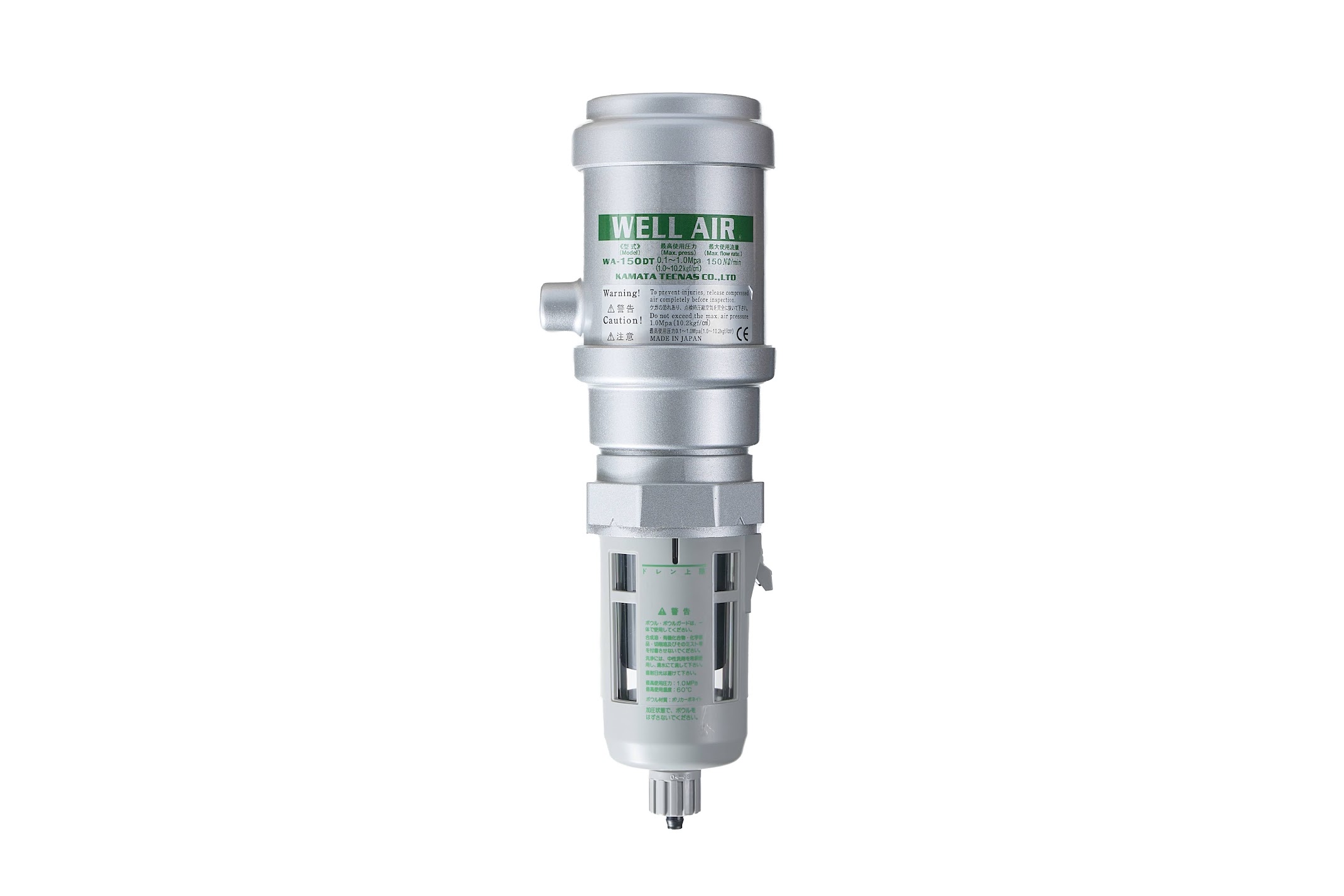
- WELL AIR pre-treats liquid droplets and coarse contaminants just before equipment.
- When fine particles or oil mist must be controlled, combining a mist filter downstream is reasonable.
- For high-precision applications, pre-treatment is important to protect downstream equipment such as membrane dryers.
First, each compressed air treatment device has a different role
There are several types of compressed air treatment devices, but they do not all perform the same job. Air dryers, filters, and WELL AIR each have different strengths, installation positions, and roles.
| Device | Main role | Main installation position |
|---|---|---|
| Air dryer | Dries the overall compressed air supply | Just after the compressor |
| Filter | Captures particles, fine particles, and oil mist | Depending on the application |
| WELL AIR | Pre-treats liquid droplets and coarse contaminants before equipment | Just before equipment |
Point: Instead of asking which device is superior, it is more useful to ask where each device should be used and what it should handle.
Why an air dryer alone may not stop water problems
An air dryer is designed to dry compressed air near the compressor outlet. However, even after air is dried upstream, liquid droplets can appear again if temperature conditions change in long piping or near the point of use.
In other words, drying the air upstream does not always prevent liquid droplets from appearing just before the equipment.
What matters in the field is not simply whether moisture exists somewhere in the plant, but whether it becomes liquid droplets right before entering the equipment. This is why upstream drying and point-of-use protection should be considered separately.
The basic idea: condition the air upstream, protect the equipment downstream
The basic approach to compressed air treatment is not to rely on one device for everything. Upstream, the overall air supply should be conditioned. At the point of use, liquid droplets that can cause trouble should be stopped. This division of roles is often the most practical approach in real factories.
Upstream
The air dryer dries the overall compressed air supply and prepares the basic air condition.
Inside the piping
Temperature changes and long piping can cause re-condensation.
Point of use
WELL AIR pre-treats liquid droplets and coarse contaminants to protect downstream equipment.
An air dryer and WELL AIR are not substitutes. They are complementary. WELL AIR does not eliminate the need for an air dryer; it covers point-of-use risks that an upstream dryer alone may not fully address.
Recommended configurations by application
The right configuration depends on the required air quality. In some cases, removing liquid droplets is enough. In other cases, fine particles, oil mist, or dew point control may also be required.
The purpose of this diagram is to show the flow simply. Each configuration adds only what is needed for the required air quality.
 WELL AIR
WELL AIR
WELL AIR
WELL AIR
WELL AIR
In short, what this diagram means
Configuration 1 is for point-of-use liquid droplet protection. Configuration 2 adds a mist filter for finer components. Configuration 3 adds a membrane dryer for high-precision air quality and dew point control. Showing only what is added at each step makes the difference easier to understand.
Why combining WELL AIR with a mist filter is effective
WELL AIR is well suited for pre-treating liquid droplets and coarse contaminants. On the other hand, when fine oil mist or fine particles must be controlled more strictly, it is reasonable to install a mist filter downstream.
By removing liquid droplets upstream of the mist filter, WELL AIR helps reduce the burden on downstream filters and makes the overall system more stable.
In other words, WELL AIR is easier to understand not as a replacement for filters, but as a pre-treatment device that helps filters do their intended job more effectively.
Why pre-protection matters in high-precision applications
When stricter drying conditions are required just before equipment, a membrane dryer may be added for dew point control. However, such downstream devices are sensitive to the air quality before them, and liquid droplets or contaminants entering the device can create risk.
If droplets or contaminants flow directly into downstream devices, they may lead to deterioration and increased replacement costs.
For this reason, high-precision applications should not force fine treatment devices to handle everything at once. A staged approach — liquid droplets and coarse contaminants → fine particles → dew point control — is important.
Key points to check first
1. Where is the problem occurring?
Identify whether the issue is near the compressor, inside the piping, or just before the equipment.
2. What needs to be stopped?
Clarify whether the issue is liquid droplets, fine particles, oil mist, or a need for lower dew point.
3. What is the current system configuration?
Check the upstream dryer, existing filters, piping conditions, and installation positions.
4. How much maintenance burden is acceptable?
Consider filter replacement, cleaning, inspection, and daily maintenance when designing the system.
Related articles
If you would like to understand the different types of air dryers or why an air dryer alone may not stop water problems, please also see the following articles.
The best configuration depends on your actual site conditions
The right combination depends on flow rate, piping length, required air quality, and existing equipment. The key is not to rely on one device for everything, but to divide roles properly.
- Water still appears even though an air dryer is installed
- You want to clarify how to use WELL AIR and filters together
- You want to discuss a configuration for high-precision applications
This article provides general information on compressed air treatment configurations. When selecting equipment, we recommend checking the required dew point, flow rate, piping conditions, and existing system configuration.